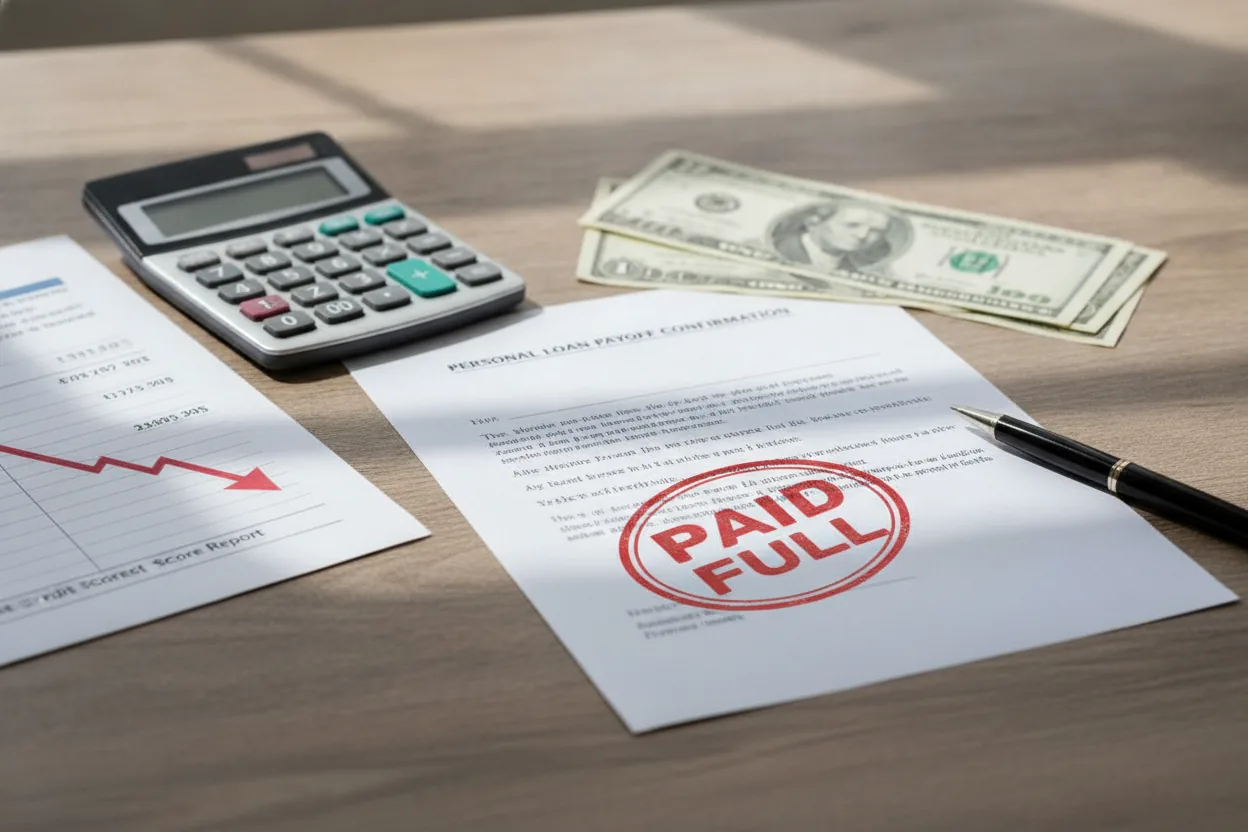
How Credit Scoring Actually Reacts to an Early Payoff
Wiping out a personal loan ahead of schedule sounds like a financial win. But it can quietly ding the very credit score you're trying to protect, touching three of the five core factors that make up your FICO score at once. So how does doing the responsible thing backfire, and when does it actually pay to keep that loan open a little longer?
- Payment history takes a hit in a subtle way: an open loan builds a running record of on-time payments, while a closed one stops adding new evidence that you pay your bills.
- Credit mix shrinks. Lenders like to see a blend of installment loans and revolving credit like cards, so losing the installment account can narrow that mix.
- Your debt-to-income ratio improves, though DTI itself isn't a factor in credit scoring. Lenders use it to judge loan affordability, and a ratio near 36% or less generally reads as favorable to them.
- A shorter credit file feels an early closure more than a file with a long history of active accounts does.
- Watch for prepayment penalties: some lenders charge a fee to recoup lost interest, a cash cost that has nothing to do with your score.
None of these factors act alone. The net effect on your score depends on how long the loan was open, what else sits on your credit report, and whether the closed account was your only installment loan. For most borrowers with an otherwise healthy credit file, this is a mechanical adjustment, not a red flag. A short-lived score dip is a normal side effect of paying off debt, nothing more.
What This Means for Your Wallet Right Now
That mechanical dip plays out differently depending on your broader financial picture, and that's where the real decision-making starts. Capital One notes that a credit score drop from paying off a personal loan early is usually minor and temporary, driven by changes to payment history, length of credit, and credit mix. SoFi adds a specific reason: the drop shows up because you stop earning on-time payment credit and may lose an installment loan from your credit mix. Compare that to missing payments or maxing out cards, which causes a much sharper decline. Not even close to the same category of problem.
- Do the DTI math: divide total debt by income, and landing near 20% or below is the threshold that tends to help your score, per OneMain Financial's guidance.
- Eliminating a loan early cuts the total interest you'd otherwise pay over the loan's remaining term. That's a direct dollar benefit, regardless of what your score does.
- Recovery is straightforward: keep other bills current, keep utilization low, limit new credit applications. SoFi frames this as the standard path back to whatever points you lost.
- Borrowers with few open accounts and a short credit history may actually lose more by closing a loan early than they gain, according to OneMain, since they give up the chance to build a longer payment record.
- One less payment to track each month means fewer chances to slip up elsewhere, an indirect credit benefit that's easy to overlook.
The real decision comes down to where you sit financially. Carrying multiple debts and a high DTI? Paying off a personal loan early is generally the stronger move for both your score and your budget. Sitting on a thin credit file with a low-rate loan? Keeping it open longer to build payment history may be worth more than the interest you'd save by closing it. Either way, check your loan terms before writing that final check. A prepayment penalty changes the math entirely, and a fee can erase the savings that made early payoff attractive in the first place. So the tension this post opened with resolves pretty cleanly: paying off a loan early only "backfires" on paper. For most borrowers with a reasonably established credit file, that temporary dip is a fair trade for lower debt and less interest paid over time.