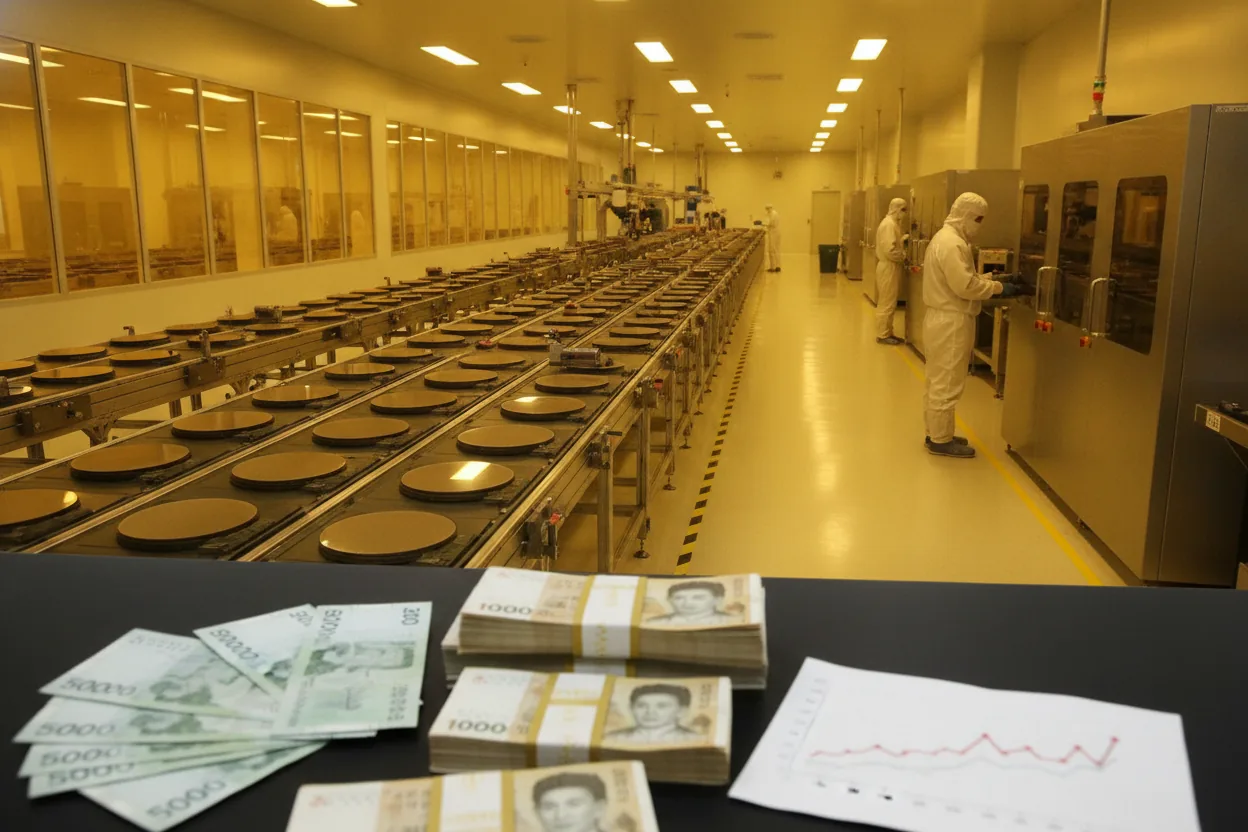
South Korea's GDP, Chip Exports, and the Semiconductor Economy's Financial Architecture
South Korea's Kospi index surged sharply over several trading sessions after Q2 2026 GDP beat consensus estimates on the back of a chip export boom, yet the Bank of Korea simultaneously delivered its first interest rate hike since 2023, threatening to squeeze the over one million variable-rate mortgage holders propping up what remains of domestic demand. Whether that collision between a roaring export economy and a tightening central bank extends the rally or kills it is exactly what the data now forces investors to figure out.
- Semiconductors represent approximately 19% of South Korea's total export revenue, making them the single largest export category by a wide margin.
- South Korea's GDP is measured in Korean Won, but chip contracts are predominantly settled in US dollars, so currency movement creates an additional layer of financial exposure for international investors that doesn't show up in the headline growth number.
- The Kospi index carries heavy weighting toward tech and semiconductor names, which is why GDP beats tend to produce outsized index moves relative to more diversified economies.
- Global memory chip prices, tracked through indices like DRAMeXchange, are treated by institutional investors as a leading indicator of South Korean export momentum, often several weeks before official GDP figures land.
- The Bank of Korea sets interest rate policy partly in response to export income flows, so a chip-driven GDP beat feeds directly into the rate environment that domestic borrowers and foreign bond investors face.
South Korean GDP isn't just a headline about one country's economy. It functions as a proxy for global semiconductor demand, and semiconductor demand is now structurally tied to AI capital expenditure cycles that ripple into US tech stocks, US data center REITs, and consumer electronics pricing worldwide. Investors tracking South Korean GDP are effectively reading the health of the global technology investment cycle before most other data points confirm it. That early-signal quality makes Korean GDP one of the more actionable macro releases on the calendar for anyone carrying semiconductor or emerging market exposure, which is precisely why the Q2 2026 beat, and the rate hike that accompanied it, carry implications well beyond Seoul.
The Q2 2026 GDP Beat, the Kospi Surge, and the Rate Hike Complicating the Recovery
South Korea's Q2 2026 GDP growth came in above consensus estimates, driven primarily by a chip export boom that offset weakness in the domestic construction sector. The Kospi responded sharply, jumping approximately 9% over three trading sessions following an earlier crash, raising questions among analysts about whether the rally reflects genuine earnings momentum or a technical rebound after oversold conditions. Then the Bank of Korea hiked rates, and suddenly a clean bullish story got messier.
- South Korea's Q2 2026 GDP growth beat street estimates, with semiconductor exports identified as the primary upside driver in official government reporting.
- The Kospi's 9% three-day gain put semiconductor-heavy South Korean equities back on the radar for emerging market fund managers who had trimmed exposure during the prior downturn.
- The construction sector's drag on GDP reflects a domestic demand problem tied to elevated mortgage debt, with an estimated over 1 million variable-rate mortgage holders now facing higher debt servicing costs after the rate hike.
- SK Hynix, a direct beneficiary of AI-driven HBM chip demand from Nvidia, sits as a core holding in several US-listed emerging market ETFs, which means the Kospi rally has a measurable impact on portfolios held by American retail investors whether they realize it or not.
- The Bank of Korea's rate hike, its first since 2023, signals that Korean policymakers are willing to accept slower domestic growth to bring inflation and debt under control, a stance that could cap how far the Kospi rally actually runs.
For US investors, the practical read on these developments runs across three channels. Semiconductor ETFs with Korean holdings, including funds with exposure to Samsung or SK Hynix, directly benefit from a GDP beat that confirms chip pricing power. US-listed chipmakers like Nvidia and AMD depend on South Korean memory suppliers to fill AI hardware orders, so strong Korean export data reduces the supply-chain risk premium that equity analysts embed in US chip stock valuations. The Bank of Korea's rate hike also adds a currency consideration: a tighter Korean rate environment tends to support the Won against the dollar, which affects the USD-denominated returns of anyone holding Korean equities through an unhedged fund.
The construction sector's underperformance is the counterweight that keeps this from being a clean bullish story. South Korean domestic consumption remains constrained by high household debt, and a central bank actively hiking rates into that environment creates the kind of bifurcated economy where export sectors thrive while ordinary consumers feel the squeeze. That bifurcation is the direct answer to the tension here: the rally is real, but its staying power depends on AI-related chip demand holding through the second half of 2026, not on any recovery in Korean domestic conditions. Investors exposed to semiconductor supply chains through US tech stocks or emerging market ETFs are the clearest beneficiaries of this data. Korean domestic sectors tied to construction and consumer credit face a materially harder road as the rate hike works its way through the economy.