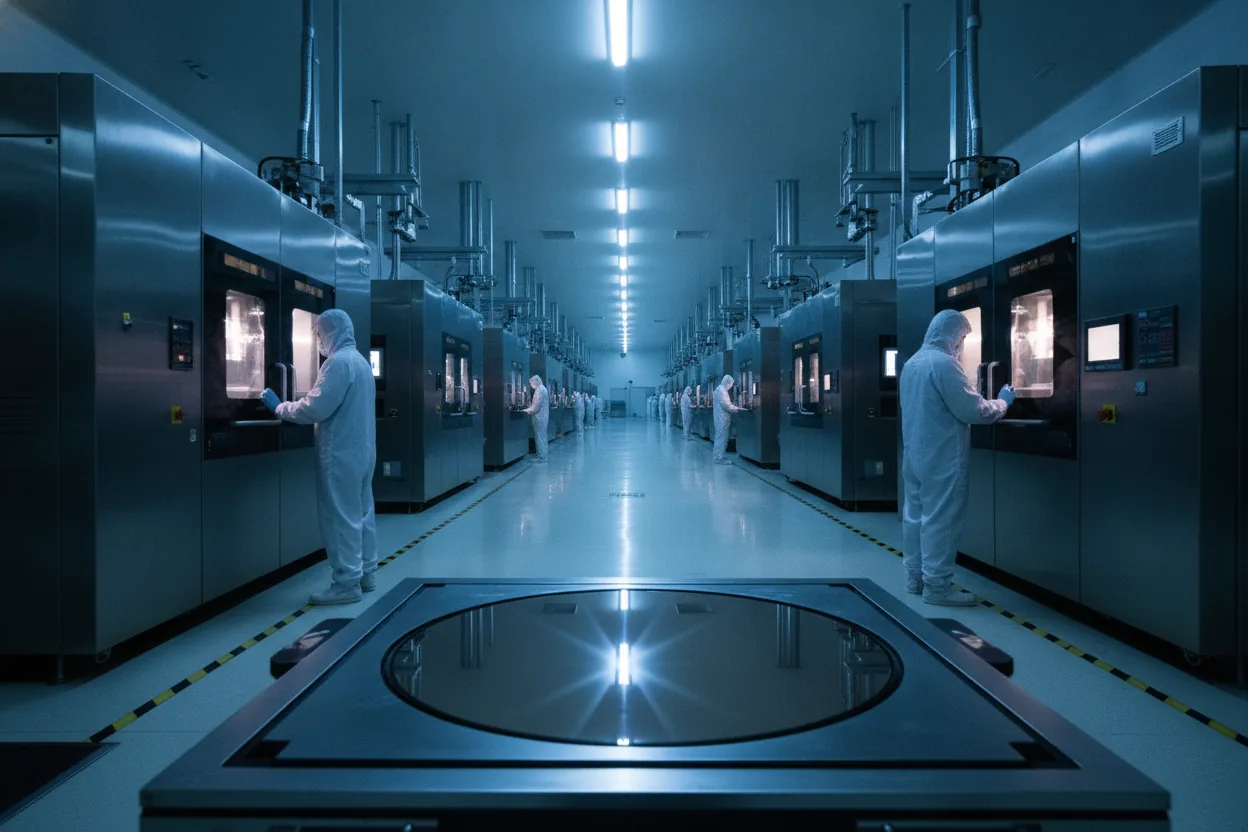
Ninety percent of the world's most advanced logic chips come out of fabs owned by one company in Taiwan, and that company doesn't design a single chip for a product carrying its own name. Apple, Nvidia, and Qualcomm design the silicon that defines the devices you buy; TSMC just builds it, at a scale and precision almost nobody else can match. That arrangement works fine until you ask what happens if the island making those chips becomes unreachable. The honest answer is that nobody fully knows. The rest of this piece traces that question through the supply chain, the geography, the audits, the earnings reports, and the diversification efforts now underway, to see how close anyone has actually come to an answer.
Taiwan Semiconductor Manufacturing Company, usually shortened to TSMC, sits at the center of this arrangement, but the real subject here is the chain itself. System companies like Apple or Ford send specifications to IC designers like Qualcomm or Nvidia. Those designers hand finished blueprints to foundries like TSMC. The foundry etches the silicon, ships it to assembly and test facilities, and the finished chip eventually lands back inside a product a consumer buys. Money and risk move through every link differently, and that asymmetry is where the interesting part of this story lives.
Mapping The Semiconductor Supply Chain Reveals Where The Real Leverage Sits
The Six Stage Semiconductor Supply Chain
Source: Article content
Tracing the loop makes the imbalance obvious fast. The chain runs from system companies to EMS firms, the electronics manufacturing services houses that physically assemble devices, to IC design shops, to IC manufacturing, to IC assembly and test, out to end consumers, and back to system companies again. Six distinct stages, each with different margins, different capital requirements, and different bargaining power. The gap between those stages is the entire story of who profits and who absorbs risk in this industry.
IC design firms like Nvidia or AMD carry no fabrication plants at all. They draw the blueprints and outsource the physical manufacturing entirely, which is why Nvidia's gross margins run above 70 percent while AMD sits closer to 50, with capital expenditure staying comparatively light for both. The foundry stage works the opposite way. TSMC's capital expenditure has run in the tens of billions of dollars annually in recent years, with money pouring into new fabs in Arizona, Kumamoto, and Taichung. That's the cost of staying at the front of a process measured in atoms, and it's why so few companies have bothered entering this business at all.
The assembly and test stage, often handled by firms in Taiwan, Malaysia, or increasingly India under its newer semiconductor incentive programs, operates on thinner margins still, closer to traditional contract manufacturing. Design firms with no fabs clear 50 to 70 percent. Assembly and test houses compete on contract manufacturing terms instead. The further downstream a company sits from the actual silicon etching, the more replaceable it becomes, and that compression of margin and leverage toward one narrow stage of the chain explains almost every pricing dynamic that follows. The companies that win here aren't the ones closest to the consumer. They're the ones nobody can route around, which is worth remembering before buying any supplier two tiers removed from the actual wafer, and it's also why Taiwan's geographic concentration, covered next, carries so much weight.
Concentrating Chip Production In Taiwan Changes The Risk Math For Everyone
Margin vs Capital Burden Across the Chip Chain
Source: Article content
If leverage in the chain concentrates at the foundry stage, then where that stage physically sits becomes the whole plot. The overwhelming majority of sub 5 nanometer chip production still happens in Taiwan, specifically in fabs clustered in Hsinchu, Tainan, and Taichung. The United States, despite the CHIPS Act and years of promised diversification, still produces only a small fraction of the world's leading edge logic chips domestically, even with TSMC's Arizona facility now running volume production on advanced nodes.
Every smartphone, every car with adaptive cruise control, every cloud server running an AI model, depends on a supply chain that funnels through one geographic point with a documented flashpoint sitting a short distance away. Analysts at firms including Capital Economics and the Rhodium Group have modeled disruption scenarios around Taiwan Strait tensions for years, and the consistent finding is that a serious disruption to Taiwanese fab output would ripple into global GDP within quarters, not years, given how embedded these chips are in sectors far beyond consumer electronics.
The CHIPS Act allocated roughly 52 billion dollars toward domestic semiconductor manufacturing and research starting in 2022, and by 2026 that money has produced visible results, including Samsung's Taylor, Texas fab and Intel's Ohio expansion. But building a fab is not the same as replicating an ecosystem. TSMC's edge comes from decades of accumulated process knowledge, a dense local supplier network, and an engineering workforce that took generations to assemble. The gap between announced capacity and actual yield at scale remains wide, and investors tend to skip right past that gap when they see a headline about a new fab breaking ground.
Tracking Supply Chain Audits Shows Who Actually Bears The Cost
Taiwan's Grip on Leading Edge Chip Production
Source: Article content
That gap between announced capacity and real output is partly a story about geography. It's also a story about who absorbs cost inside the chain once the fabs are actually running. Supply chain management in this industry runs on four stated principles: code compliance, risk assessment, audit participation, and continuous improvement. These sound like compliance department language, because they are, but the cost of enforcing them lands unevenly across the chain.
Code compliance typically means adherence to frameworks like the Responsible Business Alliance Code of Conduct, covering labor standards, environmental practices, and ethics across suppliers. For a company the size of TSMC, with thousands of suppliers feeding into its fabs, maintaining that compliance structure requires a dedicated internal apparatus, regular third party audits, and documentation trails that smaller suppliers often struggle to fund on their own. Audit participation isn't optional for a supplier that wants to stay in the chain. It's a condition of the contract, full stop.
Risk assessment took on new weight after 2020, when pandemic era shortages exposed how little slack existed anywhere in the chain. Automakers alone lost tens of billions of dollars in revenue during the 2021 chip shortage, with AlixPartners putting the industry wide figure near 210 billion dollars, largely because the auto industry had negotiated thin, just in time contracts with chip suppliers who prioritized higher margin customers like smartphone makers when capacity got tight. That's not a conspiracy. That's a foundry allocating scarce capacity toward whoever pays more per wafer, which is exactly what a business does when demand exceeds supply.
Continuous improvement sounds soft, but in practice it means constant pressure on suppliers to cut costs or improve yield, pressure that gets passed down the chain faster than it gets passed up. The supplier two tiers below TSMC, making a specialty gas or a photomask, absorbs cost pressure that never quite reaches the end consumer's phone price. The structure consistently rewards whoever sits closest to the design and furthest from the physical manufacturing risk, confirming the same pattern laid out in the leverage section above: proximity to the wafer determines who pays and who collects.
Reading TSMC Earnings Reports Shows Where The Pricing Power Actually Lives
The audit and cost data show who absorbs pressure inside the chain. TSMC's own financial disclosures show what that pressure is worth in dollars, and they tell a clear story about where pricing power sits in 2026. Revenue growth has been driven heavily by its most advanced nodes, with 3 nanometer and below technology accounting for a majority of wafer revenue in recent quarters, according to the company's own quarterly filings. Gross margins have stayed above 60 percent even as TSMC absorbs higher costs from overseas expansion in Arizona and Japan, facilities that its own executives have acknowledged run less efficiently than the home fabs in Taiwan.
That margin resilience matters because it tells you something about elasticity. Customers like Apple and Nvidia, desperate for leading edge capacity, have limited alternatives. Samsung Foundry and Intel's foundry services both compete at the bleeding edge, but neither has matched TSMC's yield rates on the most advanced nodes consistently enough to pull meaningful volume away. When a buyer has nowhere else to go, the seller sets the price, and the seller's margin reflects exactly that reality.
The IC design layer looks different. Competition there is fierce and visible. Qualcomm, MediaTek, and Nvidia fight constantly over smartphone and AI accelerator market share, and that competition shows up as margins compressing in commoditized segments while staying strong in differentiated ones like high end AI chips. Pricing power inside this chain depends entirely on how replaceable a given stage is, and right now, leading edge fabrication is the least replaceable stage that exists in global manufacturing, period. That single fact matters more to a semiconductor stock's valuation than almost any other variable analysts quote.
Watching Diversification Efforts Signals Where The Next Decade Points
TSMC's pricing power rests on being irreplaceable, which is exactly the condition every major government with semiconductor ambitions is now trying to undo. Each is running some version of the same playbook: subsidize domestic fabs, restrict export of advanced equipment, and hope a decade of investment narrows the gap with Taiwan. The United States, the European Union through its own Chips Act, Japan, India, and South Korea have all committed public money to this effort since 2022, and the combined figure across these programs now runs into the hundreds of billions of dollars.
Progress is real but slower than the press releases suggest. Micron, Intel, Samsung, and TSMC have all broken ground on new US fabs, and some are now producing chips, but the most advanced processes, the ones below 3 nanometers, remain concentrated overwhelmingly in Taiwan through at least the end of this decade based on current fab construction timelines. Equipment makers like ASML in the Netherlands, which produces the extreme ultraviolet lithography machines required for the smallest nodes, have also become choke points in their own right, with export restrictions to China reshaping where that equipment can even be sold.
A meaningful slice of a broad tech index fund's return depends on a supply chain structure that governments are actively trying to change but cannot change quickly. That's the answer to the question this piece opened with: nobody fully knows what happens if Taiwan becomes unreachable, because no alternative source of leading edge capacity exists yet, and current fab timelines say none will exist before the early 2030s at the earliest. The concentration that exists today isn't a temporary glitch waiting to resolve. It's the system working exactly as its decades of specialization and capital requirements built it to work, and the next geopolitical headline out of the Taiwan Strait will land on portfolios long before diversification efforts land any real relief.
This article is for informational and educational purposes only and does not constitute financial, investment, legal, or insurance advice. The views expressed are analytical observations and should not be relied upon for personal financial decisions. Always consult a qualified financial advisor before making investment or insurance decisions.