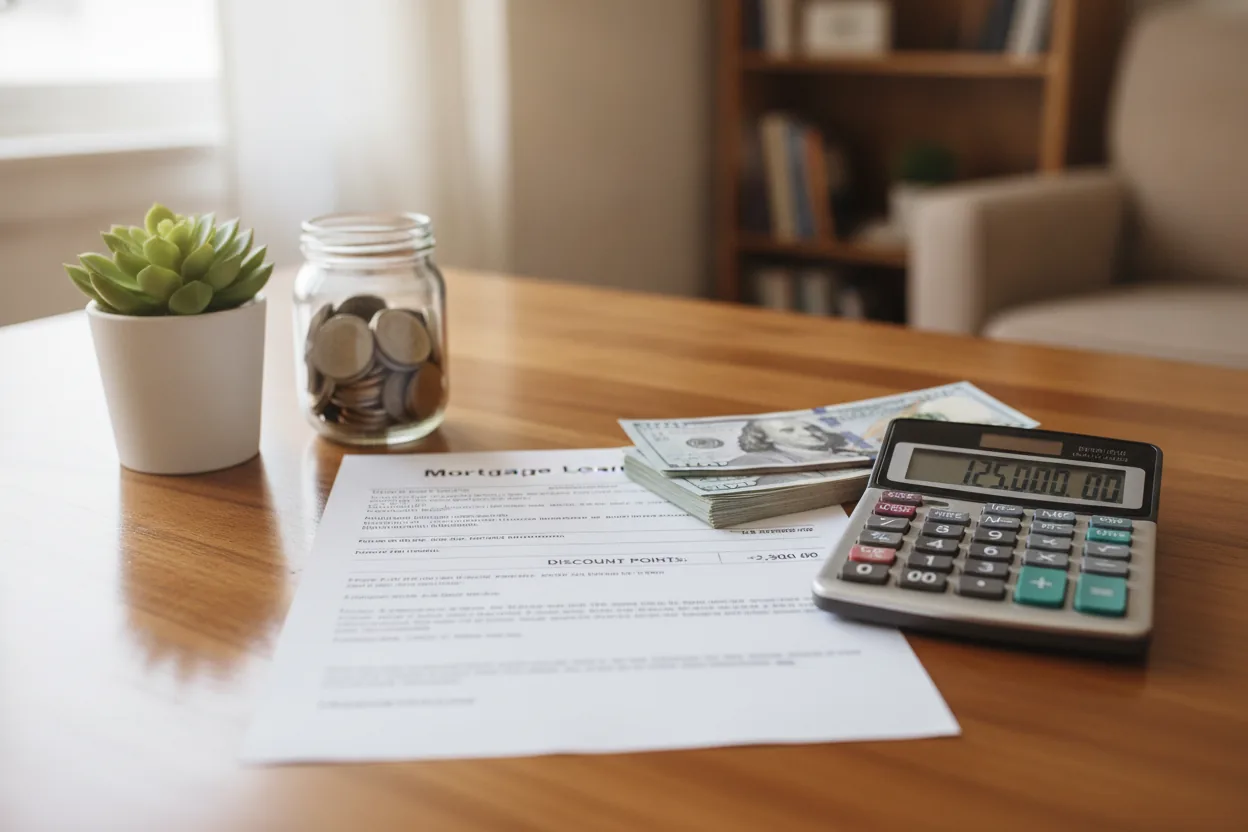
What Mortgage Points Actually Cost and Save
Pay $3,000 to buy a mortgage point and you won't fully recoup that cost for 10 years, all to save just $25 a month. So is that upfront cash better spent buying down your rate, or would it grow faster sitting in a down payment or an investment account instead?
- 1 point on a $400,000 loan runs $4,000 upfront at closing.
- Rate reduction per point: 0.125% to 0.25%, per Chase and Rocket Mortgage guidance.
- You get the savings as a lower monthly payment, not a lump sum refund.
- Break-even formula: Cost of Points divided by Monthly Savings, expressed in months.
- Take a $3,000 point that saves $25 a month. That breaks even at 120 months, or 10 years.
The math itself isn't complicated. What makes this hard is that nobody can guarantee how long they'll keep a loan. Buy points on a mortgage you refinance or sell in five years, and you've essentially handed the bank an interest-free loan on your own money. For most buyers, points are a bet on your own future, not a guaranteed win.
Points vs. Down Payment vs. Investing the Cash
That uncertainty about your timeline is exactly why the real question isn't points versus no points. It's what else that same cash could do: a bigger down payment, a brokerage account, an emergency fund. Chase frames this directly as a choice between buying down the rate and putting more money down, since both reduce loan costs, just through different mechanisms. A larger down payment lowers your loan-to-value ratio and can eliminate private mortgage insurance (PMI) entirely. Points only touch your rate.
- Take that same $3,000 point saving $25 a month: you don't see a real payoff until past year 10 of the mortgage.
- Sell or refinance before you hit break-even, and that upfront cost never comes back.
- Put the cash toward points instead of a down payment, and you might end up paying PMI longer if your loan-to-value ratio stays above 80%.
- Cash diverted to points is cash that isn't sitting in a diversified investment portfolio, compounding over that same 10-year window.
- Buy more points and your total interest savings grow over the life of the loan, according to Rocket Mortgage, but only if the loan actually runs long enough to get there.
Points give you a guaranteed, slow-payoff return in the form of interest saved. Investing that same cash is a variable bet that might beat that guarantee or might lose to it, depending entirely on which decade you're living through. Stay in the home 10-plus years and points act like a low-risk, fixed-rate investment against your own mortgage. Expect to move, refinance, or want cash on hand for markets or emergencies, and keeping the money usually wins out, since a rate cut you never get to enjoy for the full stretch is money spent for nothing. So the question this post opened with comes down to one answer: no spreadsheet decides this for you. It's how sure you are about how long you'll actually stay in the house.