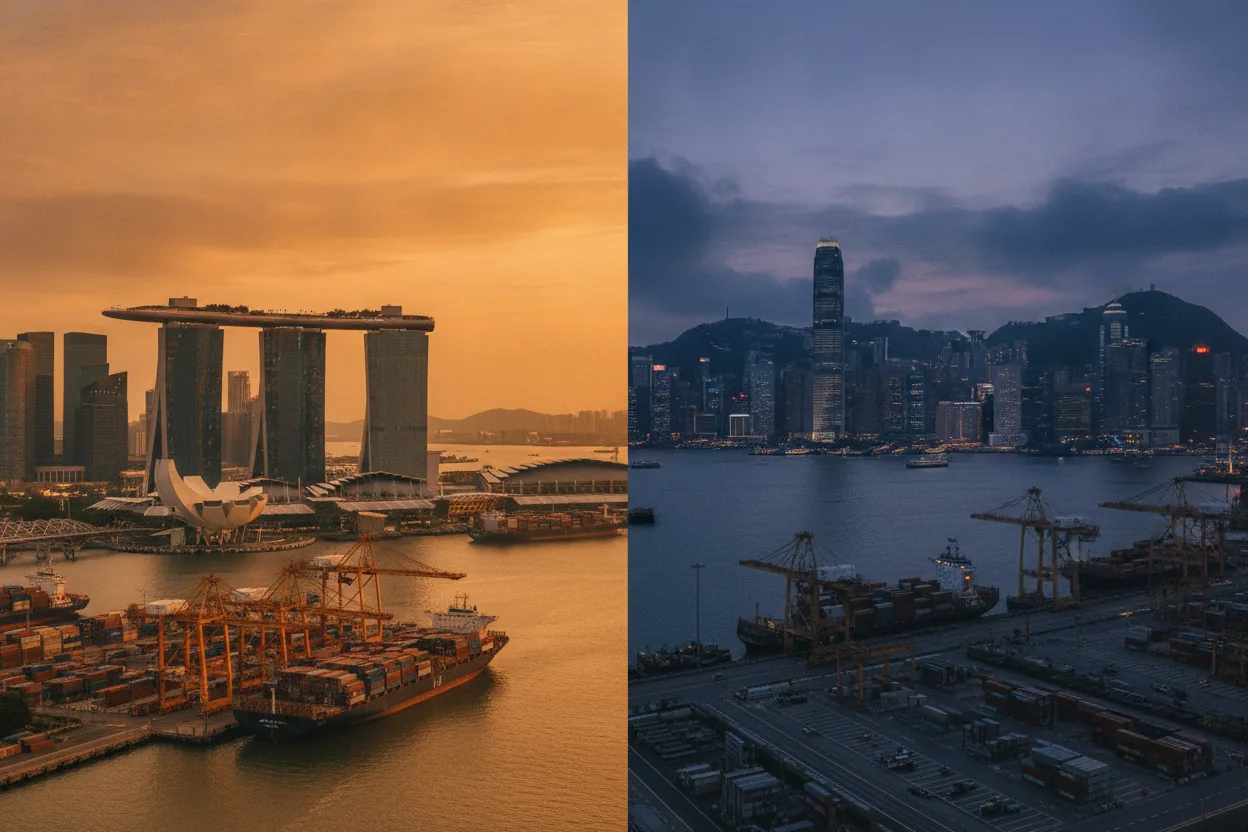
Singapore and Hong Kong as Competing Asian Financial Hubs
After the US pushed average tariffs on Chinese goods to 38 percent following April 2026's escalation, Singapore's non-oil domestic exports surged an estimated 11.3 percent year-on-year while Hong Kong retail sales fell 6.1 percent over the same stretch. That split between Asia's two dominant financial hubs now forces every investor in an Asia-Pacific ETF to ask a pointed question: is this divergence a temporary trade-war distortion, or a permanent repricing of Hong Kong risk?
- Singapore's primary role as the hub for Southeast Asian private wealth management, with assets under management estimated at SGD 5.4 trillion as of the latest Monetary Authority of Singapore annual report.
- The Hang Seng Index covers roughly 80 or more constituent companies across finance, real estate, and technology, making it the go-to benchmark for broad China-linked equity exposure.
- The Singapore Exchange (SGX) lists several hundred companies, with average daily securities trading volume estimated at approximately SGD 1.2 billion in early 2026.
- The Hong Kong dollar's currency peg to the US dollar sits within a band of 7.75 to 7.85, managed by the Hong Kong Monetary Authority. The peg itself dates to 1983; the current trading band has been in place since 2005.
- The Monetary Authority of Singapore manages monetary policy through the Singapore dollar nominal effective exchange rate rather than an interest rate instrument, a structurally distinct approach that most central banks simply don't use.
Institutional investors have always had to choose how to allocate between these two cities when building Asia-Pacific portfolios. That choice is getting harder to dodge now that their trajectories are clearly diverging. For anyone holding iShares MSCI Hong Kong ETF (EWH), iShares MSCI Singapore ETF (EWS), or broad Asia funds like Vanguard FTSE Pacific ETF (VPL), the structural differences between these markets aren't academic background reading anymore. They're the foundation for any position sizing decision. Singapore's deeper ASEAN integration and independent exchange rate framework give it a meaningful structural edge for investors seeking insulation from China-linked credit risk. That's not a close call at this point.
Why Singapore and Hong Kong Economy Is Trending in July 2026
A cluster of mid-July 2026 developments is directly changing how investors and businesses price risk across the region. The US-China trade framework negotiations, grinding along since the April 2026 tariff escalation, have placed both cities at the center of global supply chain rerouting decisions. Singapore has pulled in significant manufacturing and logistics investment as companies redirect goods through ASEAN channels to sidestep direct China-to-US tariff exposure. Hong Kong, by contrast, faces mounting pressure from its deep financial and political integration with mainland China's still-troubled property and credit markets.
- Singapore's non-oil domestic export growth hit an estimated 11.3 percent year-on-year in June 2026, driven by electronics and pharmaceuticals rerouted through Singapore-based intermediaries, per Enterprise Singapore data released in mid-July 2026.
- Hong Kong posted a 3.2 percent unemployment rate in Q2 2026 alongside retail sales falling roughly 6.1 percent year-on-year in May 2026, both reflecting continued weakness in consumer spending tied to subdued mainland Chinese tourism.
- The Hang Seng Index closed at approximately 22,400 on July 18, 2026, down roughly 4 percent month-to-date, as markets priced in renewed concerns about Chinese property developer debt restructuring. Progress on that front has been slow, to put it charitably.
- Singapore's Straits Times Index held near 3,850 as of July 21, 2026, outperforming regional peers amid expectations that the Monetary Authority of Singapore will maintain its current exchange rate policy stance at the October 2026 meeting.
- BlackRock and several other major asset managers, in their mid-year allocation notes from July 2026, recommended overweight positions in Singapore REITs and underweight on Hong Kong property equities, citing diverging rental yield trajectories.
The practical money question for US-based investors is whether this divergence between the two hubs is a temporary trade-war artifact or a structural repricing of Hong Kong's risk premium relative to Singapore. Singapore's fiscal position is solid, with government reserves estimated to exceed SGD 1 trillion, which provides a credible buffer against external shocks. Hong Kong's linked exchange rate system is a different story. It keeps borrowing costs mechanically tied to US Federal Reserve decisions, which means the Fed's current rate environment of 4.25 to 4.50 percent directly pressures Hong Kong mortgage holders and property valuations with no local policy offset available whatsoever. That's a real constraint, not a theoretical one.
Investors holding Asia-Pacific exposure through broad ETFs or individual equities need to actively check their fund's country weighting breakdown. The two cities are moving in opposite directions, and passive exposure to both simultaneously is no longer a neutral position. For most retail investors with broad Asia-Pacific ETF holdings, the evidence favors a deliberate tilt toward Singapore-weighted instruments and a reduction in unhedged Hong Kong property equity exposure until Chinese credit conditions stabilize.