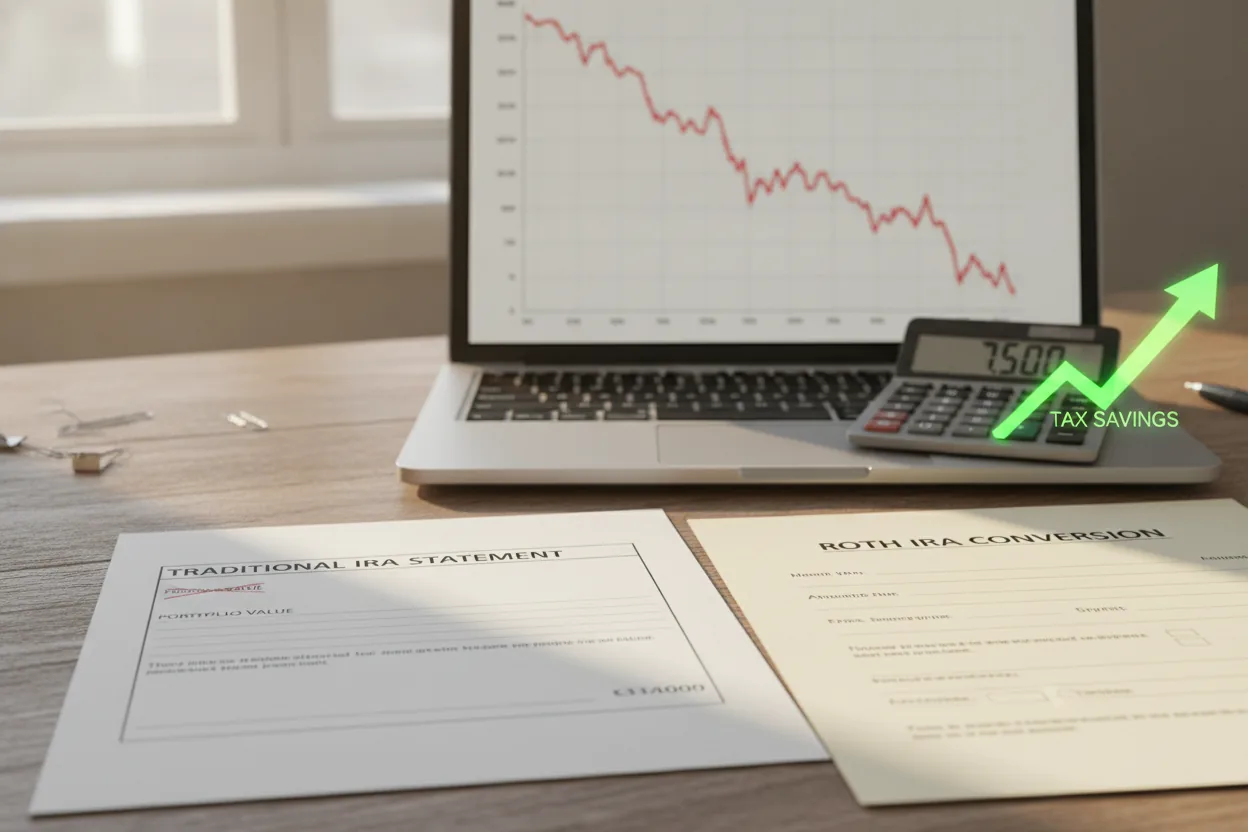
The Mechanics Behind a Roth IRA Conversion and the Built-In Market Dip Discount
Peter Thiel seeded a Roth IRA with approximately $2,000 in 1999 and watched it grow to an estimated $5 billion completely tax-free. The same structural logic that made his account untouchable by the IRS is available to ordinary investors right now, during a window that closes the moment markets fully recover. If a $500,000 traditional IRA has dropped to $400,000 during a market dip, converting today versus at peak value saves $24,000 in federal taxes at the 24% bracket alone. The question is whether most investors understand exactly how to execute that conversion before the discount disappears permanently.
- Traditional IRA contributions are pre-tax, meaning the IRS has never collected on that money. Every dollar of growth and principal carries a deferred tax liability waiting to be triggered.
- Roth IRA growth and qualified withdrawals are permanently tax-free, including all future appreciation after the conversion date.
- A $500,000 traditional IRA converted at a 24% federal rate generates a $120,000 tax bill. Convert that same account after a dip has pushed it to $400,000, and the bill drops to $96,000. That's $24,000 saved on a single transaction.
- Required Minimum Distributions kick in at age 73 under the SECURE 2.0 Act, which means large traditional IRA balances create forced taxable withdrawals whether you need the income or not.
- Thiel's Roth, seeded with founder's shares in PayPal around 1999, grew to an estimated $5 billion tax-free, which is the most extreme illustration of what happens when you strip future gains out of a taxable account entirely and let compounding run uninterrupted for decades.
The Roth conversion strategy works best when three conditions line up at once: the account value is temporarily depressed, your current marginal rate is lower than what you expect to face later, and you have outside cash to cover the tax bill without touching the converted assets. Raid the IRA itself to pay the taxes and you've just shrunk the amount you converted and surrendered decades of tax-free growth on those dollars. Investors who nail all three conditions lock in a structural tax advantage that compounds quietly for years, which is why a market dip is one of the most genuinely actionable personal finance windows that comes around.
Why Market Conditions in Mid-2026 Are Driving Roth Conversion Interest Right Now
US equity markets got choppy in the first half of 2026. The S&P 500 pulled back an estimated 10 to 15 percent from its late-2025 highs before partially recovering through July, which reopened the conversion math for millions of IRA holders who had been effectively priced out when account values were sitting near records. The 24/7 Wall St. analysis using the $500,000 benchmark made the dollar figures concrete: a full-account conversion during a 20% dip saves roughly $24,000 in federal taxes at the 24% bracket, and proportionally more as the bracket climbs.
- At the 32% federal marginal rate, a $100,000 reduction in converted value saves $32,000 in taxes on a single conversion event.
- The 2026 Roth IRA contribution income phase-out starts at $153,000 for single filers and $236,000 for married filing jointly, but there is no income limit on conversions. High earners locked out of direct contributions can still use this.
- The current top federal marginal rate of 37% applies above $609,350 for single filers in 2026, so high-income earners converting large balances face the steepest bills and stand to gain the most from converting while account values are still depressed.
- State taxes stack on top. California's 13.3% top rate means a resident there converting $500,000 faces a combined marginal rate above 50%, which makes every dollar shaved off the converted amount worth considerably more than it looks on a federal-only spreadsheet.
- The Thiel case, cited heavily in mid-2026 financial media, reinforced the core point: Roth accounts have no cap on growth, no RMDs, and no tax on distributions. Converting depressed assets early is the highest-leverage version of that same strategy for anyone who isn't a PayPal founder.
The practical execution comes down to three decisions made at roughly the same time: which assets to convert (equity-heavy positions with strong recovery potential are the obvious candidates), exactly when to pull the trigger rather than drifting through a rising market, and how you're funding the tax bill. Paying conversion taxes out of the IRA itself is a mistake that's easy to make and painful in retrospect. It reduces the converted amount and surrenders all the future tax-free growth on those dollars. For investors sitting on large traditional IRA balances built up over long, high-savings careers, converting during a 15% dip rather than at peak value could save more than $18,000 in federal taxes at the 24% bracket. One decision, permanent consequences.
The investors with the most to gain from the mid-2026 window are probably in the 50 to 62 age range: past peak earning years, still a decade or more from RMD age, holding large pre-tax balances that have partially recovered but haven't fully clawed back 2025 highs. For that group, the combination of a still-depressed account value, known current tax rates before any post-2025 legislative changes land, and a long runway of tax-free compounding ahead makes this one of the most financially meaningful decisions on the table. Wait for accounts to fully recover, and you pay the higher bill. Every dollar of that dip discount you didn't use is gone for good.