What Private Mortgage Insurance Is and How It Affects Your Mortgage Costs
A borrower paying $200 per month in private mortgage insurance who reaches the 80% loan-to-value threshold just six months early saves $1,200 in insurance costs alone, yet that money flows entirely to the lender's protection, not the homeowner's. The federal rules that let borrowers cancel PMI before the lender's automatic deadline exist, but only those who know exactly when and how to act on them will stop paying for coverage that was never theirs to begin with.
- PMI applies specifically to conventional mortgage loans, not FHA loans, which carry a separate federal mortgage insurance premium structure
- Annual PMI costs on a sizeable loan balance can add a meaningful amount per month to a borrower's payment depending on the rate applied
- PMI premiums are paid by the homeowner, with policy coverage flowing entirely to the lender's financial protection
- The loan-to-value ratio (LTV) is calculated by dividing the outstanding loan balance by the home's purchase price or appraised value at closing, whichever is lower
- Borrowers who refinance reset the LTV clock using the appraised value at the time of refinancing as the new baseline for PMI calculations
PMI is a direct tax on low down payment buyers. It transfers financial risk off the lender's books while adding a real monthly cost to the borrower's budget. Understanding its structure matters because removing it early can recover hundreds of dollars per month in cash flow that can be redirected toward principal paydown, retirement contributions, or other investments. The specific federal rules that govern removal are where that understanding becomes actionable.
The Specific Rules for Canceling PMI and How to Act on Them
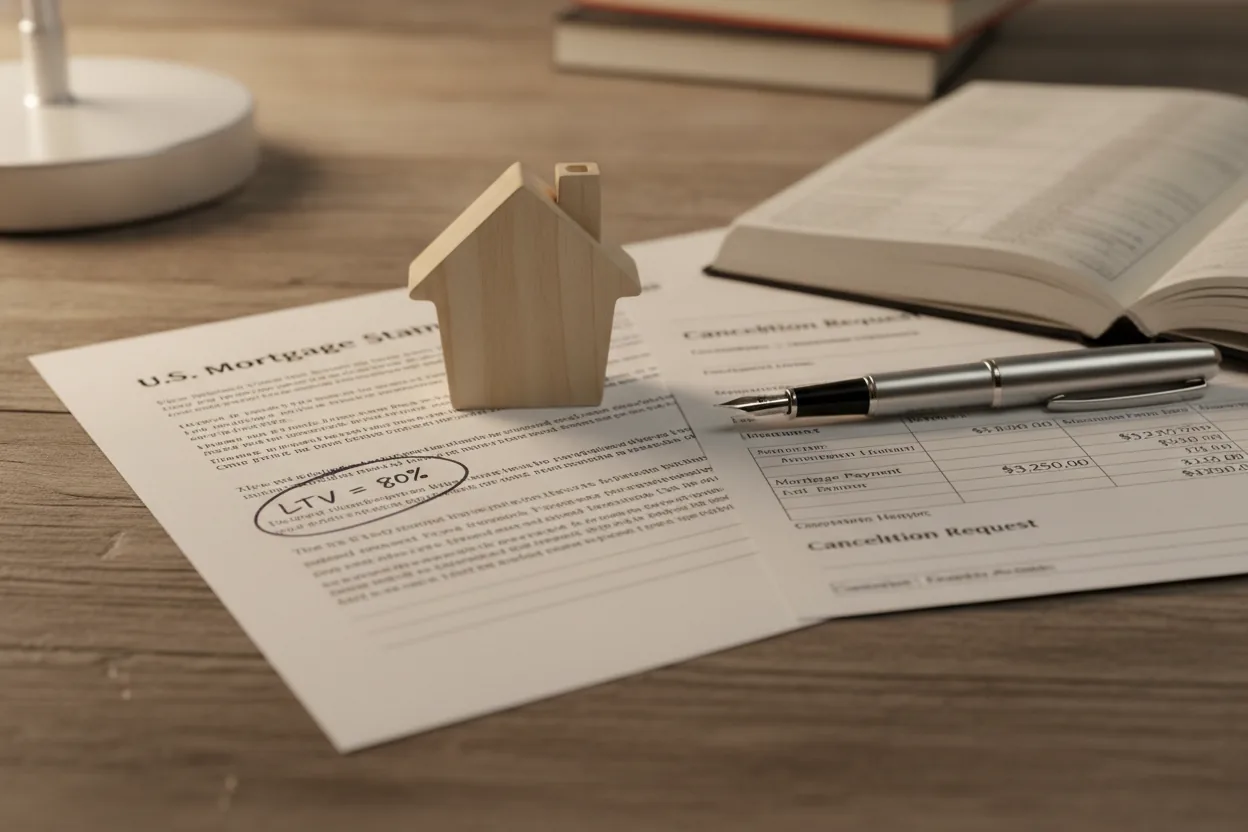
Federal law under the Homeowners Protection Act sets two mandatory thresholds that govern PMI removal on conventional loans, and acting on the earlier one saves real money. At 80% LTV, the borrower has the right to request cancellation in writing. At 78% LTV, the lender is legally required to cancel PMI automatically, provided the borrower is current on payments. The Consumer Financial Protection Bureau confirms that if a borrower is behind on payments when the 78% threshold is reached, automatic termination is delayed until the account is brought current.
- At 80% LTV, you can submit a written cancellation request to the loan servicer based on the original purchase price or appraised value at closing
- At 78% LTV, the servicer is required to cancel PMI automatically on the scheduled date according to the original amortization schedule, but only if you're current on payments
- The projected 80% LTV date appears on the PMI disclosure form your lender provides at closing, and it's worth finding that document now if you haven't already
- If your home's market value has risen since purchase, you may qualify for early cancellation based on current equity, which typically requires a new appraisal at your expense
- For FHA borrowers, a full refinance into a conventional loan is often the only real path to eliminating mortgage insurance entirely
Fannie Mae's homebuyer resources point to the amortization schedule as a key planning document: it provides the precise date a loan balance is projected to hit 80% of original value, giving borrowers a concrete target to work toward. The practical move is to contact the loan servicer proactively when the balance approaches 80% LTV rather than waiting for the automatic 78% termination, since that single action can eliminate several months of unnecessary PMI payments.
Extra principal payments accelerate the timeline. Making even one additional principal payment per quarter can move the 80% LTV date meaningfully earlier, and the math works in the borrower's favor: the cost of an extra payment is recovered quickly once PMI is removed. For a borrower paying $200 per month in PMI, reaching the 80% threshold six months early saves $1,200 in insurance costs, not counting the interest savings from the lower principal balance.
Borrowers in markets where home values have appreciated significantly hold another lever. If the current appraised value pushes the LTV below 80% based on today's market price rather than the original purchase price, a servicer may approve early cancellation after a new appraisal. The breakeven calculation is straightforward: if monthly PMI is sufficiently high, the appraisal fee pays for itself within a few months of cancellation.
One structural limitation is worth building into your planning. PMI cancellation requests based on original value generally require a solid payment history, with commonly cited standards suggesting no 30-day late payments within a recent 12-month window and no 60-day late payments within a recent 24-month window, though exact requirements vary by servicer. Falling behind on payments doesn't just delay the automatic 78% termination. It can disqualify a borrower from the earlier 80% request entirely until the account is restored to current status.
Refinancing resets the entire PMI framework. A borrower who refinances starts a new loan with the appraised value at refinancing as the new LTV baseline, which can work for or against them depending on whether home values have moved since the original purchase. Refinancing into a conventional loan from an FHA loan is often the only path to eliminating FHA mortgage insurance entirely, and the decision requires comparing the new interest rate, closing costs, and projected PMI savings against the total cost of staying in the existing loan.
The borrower who wins here is the one who pulls out the original amortization schedule, identifies the projected 80% LTV date, sets a calendar reminder, and contacts the servicer proactively at that milestone rather than waiting for the automatic 78% cancellation. That is precisely how the federal rules reward those who know when and how to act on them, while everyone else keeps funding the lender's insurance arrangement one avoidable monthly payment at a time.