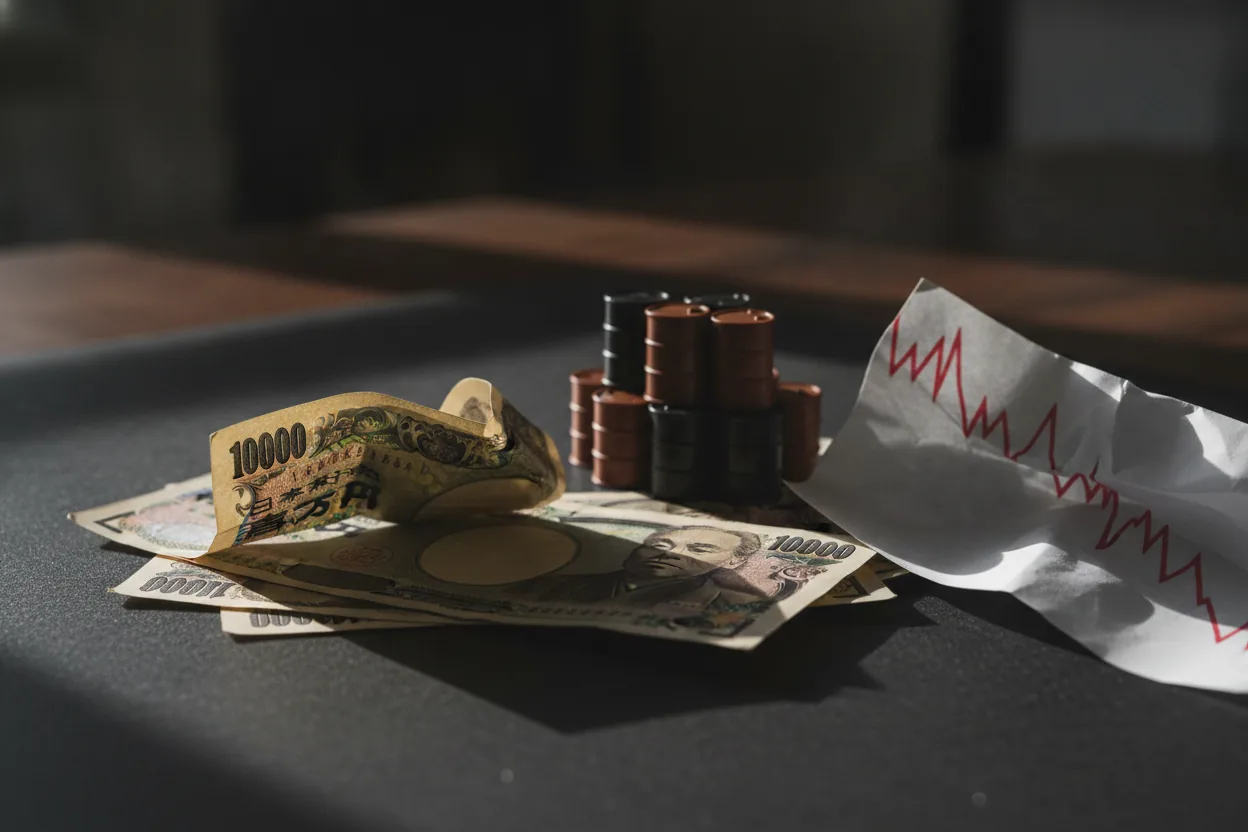
The Japanese Yen's 40-Year Low and the Debt Crisis Behind It
Japan's Ministry of Finance spent what some estimates suggest was among the highest amounts ever recorded intervening in currency markets in 2024 alone. A record-breaking effort that still couldn't stop the yen from sinking to its weakest level against the dollar since 1986. Now, with oil crossing $100 a barrel and an estimated $500 billion in US equity and Treasury positions tied to the yen carry trade, every investor needs to answer one question: will the next Bank of Japan policy meeting be the shock that finally forces a reckoning across global portfolios?
- Japan's public debt sits at what widely cited figures indicate is among the highest ratios among G7 nations by a wide margin, a fiscal burden that quietly erodes investor confidence in the yen over time.
- The Bank of Japan's benchmark policy rate stayed below 0.5% through most of 2025 and into 2026, while the US Federal Reserve held its rate above 4%. That gap doesn't just pressure the yen lower, it practically invites carry traders to pile in.
- The yen carry trade works like this: borrow yen at near-zero rates, deploy those funds into US Treasuries or equities, pocket the spread. Estimated outstanding positions run into the trillions globally, making this one of the most structurally loaded trades in the world right now.
- Japan's 10-year government bond yield hit approximately 1.6% in mid-2026, its highest level in over three decades, reflecting genuine domestic skepticism about Tokyo's debt management.
- Despite reaching what some analysts called record intervention spending in 2024, the Ministry of Finance ultimately failed to reverse the yen's downward trend. At some point, the market just stops caring how much you spend.
Record debt, ultra-low rates relative to the rest of the developed world, and a structurally shrinking population that slowly eats away at Japan's long-term tax base: these three forces are feeding each other in a cycle that keeps the yen under pressure. For investors holding US assets, this matters more than most realize. A rapid carry trade unwind, triggered by a sudden Bank of Japan rate hike, could send shockwaves through global equity and bond markets within hours, not weeks. Ignoring Japan's fiscal trajectory right now means leaving one of the most consequential portfolio risks of 2026 sitting completely unexamined.
How the Yen Crisis and $100 Oil Are Hitting Your Finances Right Now
That structural fragility is now running headlong into a second, immediate shock. As of July 26, 2026, two converging pressures are making this story genuinely urgent for American investors and consumers. Oil has surged past $100 per barrel following escalating shipping disruptions in the Middle East, a price level not seen in several years, and a weak yen is compounding Japan's import pain because Tokyo buys virtually all of its oil in US dollars. Separately, the US Treasury Department's decision to keep South Korea on its currency monitoring list signals that Washington is watching Asian currency dynamics with unusual intensity. Yen weakness is sparking broader regional currency competition, and that has direct trade implications for the US economy.
- Brent crude crossing $100 per barrel is expected to raise US gasoline prices by an estimated 20 to 30 cents per gallon on average, with the full effect typically arriving over a 4 to 6 week lag. That's a direct, unavoidable hit to household budgets.
- Japan imports roughly 90% of its energy. A yen at a 40-year low combined with $100 oil isn't just painful for Japanese consumers, it's a double inflation shock that raises the real possibility Tokyo starts pressuring the Bank of Japan to hike rates faster than markets are currently pricing in.
- South Korea's continued placement on the US Treasury currency monitoring list, confirmed in the July 2026 report, tells you Washington sees a pattern: Asian export competitors managing currency weakness to gain trade advantages. The yen's slide is actively fueling that dynamic across the region.
- Should the Bank of Japan hike rates sharply to defend the yen, analysts at major institutions estimate the resulting carry trade unwind could pull $500 billion or more out of US equities and Treasuries within weeks. That's a liquidity event, not a footnote.
- Short-term earnings boosts for Japanese automakers, electronics firms, and industrial exporters listed on the Tokyo Stock Exchange from yen weakness temporarily inflate the yen-denominated returns on US-listed Japan ETFs like EWJ, which masks the underlying structural fragility sitting just beneath the surface.
For American consumers, the pressure shows up first at the gas pump and in the price of imported goods, since oil above $100 feeds directly into transportation costs across the entire supply chain for groceries, electronics, and retail. For investors, the deeper risk is portfolio concentration. Anyone holding broad international equity funds has meaningful Japan exposure, and a disorderly yen adjustment, whether triggered by a Bank of Japan policy pivot or a sovereign debt rating downgrade, could reprice that exposure sharply and fast. The question posed at the outset was whether the next Bank of Japan meeting becomes the trigger for a global market shock. The answer depends on what you do before that meeting: audit your Japan exposure, check whether your international ETFs are hedged or unhedged on currency, and treat the Bank of Japan's rate signal as the single most actionable data point in global markets right now, not some distant debt ceiling debate.