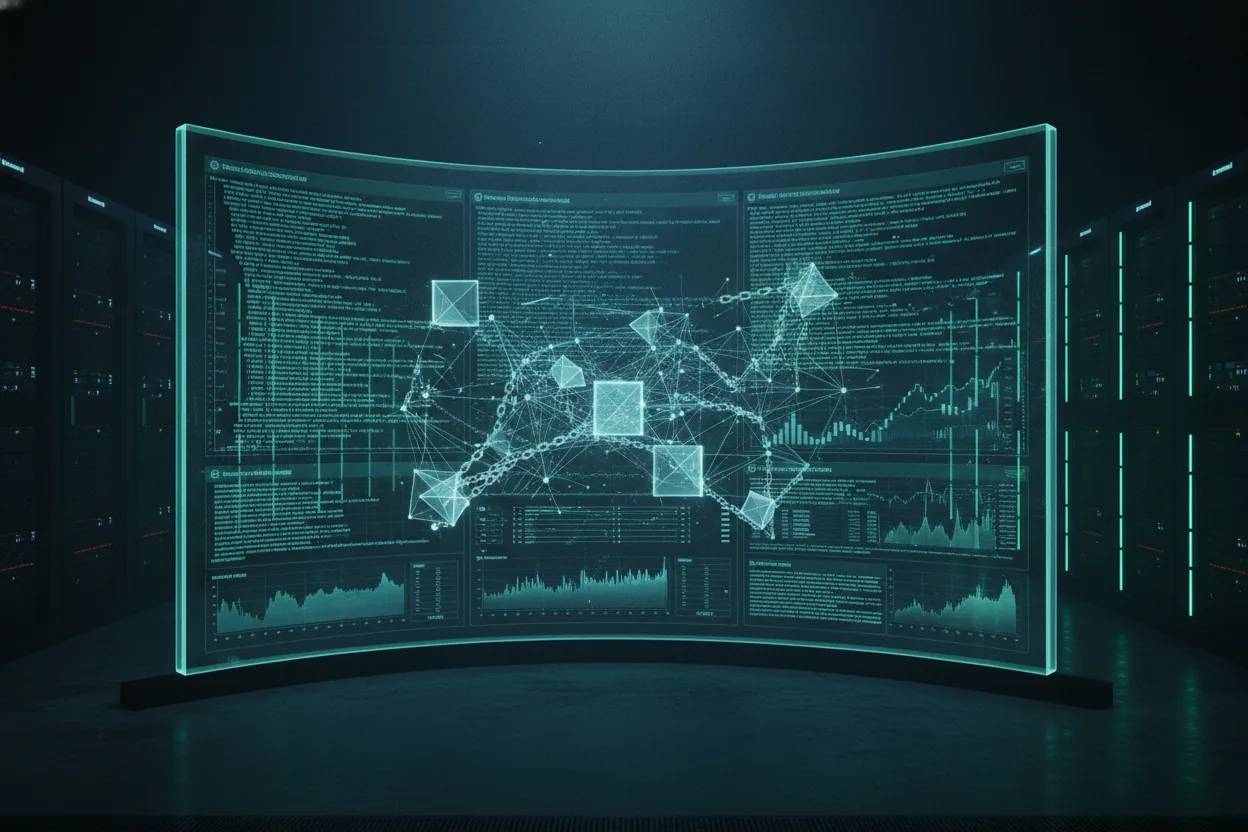
Widely cited industry figures suggest fraud detection systems running on blockchain networks flagged suspicious DeFi activity reaching into the billions of dollars in 2025. That number didn't come from a marketing deck. It came from a specific architecture built by teams who had already absorbed billions in losses from smart contract exploits. The engineers who designed these systems built them to protect protocol liquidity, and the capital flowing into DeFi today benefits directly from that pain-driven engineering in ways most users never see. But layering AI judgment onto immutable ledgers raises a question the industry hasn't fully answered: when the intelligence embedded in a system is adaptive and opaque, how do you actually verify the trust it claims to provide.
The core argument here is mechanical, not promotional. AI brings pattern recognition, prediction, and adaptive decision making. Blockchain brings auditability, finality, and tamper resistance. When those two properties combine inside the same system, they produce something neither technology delivers alone: intelligence you can verify. That specific combination is now reshaping how DeFi protocols manage risk, how tokenized assets get priced, and how governance decisions get made across decentralized networks.
Why Security Became the First AI Proving Ground
How AI and Blockchain Stop DeFi Exploits in Real Time
How AI and Blockchain Stop DeFi Exploits in Real Time
Onchain AI monitors velocity, wallet clustering, and liquidity movements simultaneously
AI flags behavior matching known exploit signatures: reentrancy, flash loan attacks, integer overflow
Blockchain finalizes transactions in seconds, so AI must act faster than human review allows
Smart contract pauses automatically, blocking fund outflow before exploit completes
Every flagged event is recorded on-chain, providing verifiable, tamper-resistant incident history
Source: Article: How AI and Blockchain Are Rebuilding Financial Trust in 2026
Source: Article: How AI and Blockchain Are Rebuilding Financial Trust in 2026
Smart contract exploits have cost the crypto ecosystem tens of billions of dollars since 2020. The pattern is almost always the same: a vulnerability sits in code that was audited by humans, missed because the attack vector was novel or the interaction between contracts was too complex to trace manually. AI auditing tools trained on historical exploit data can now flag reentrancy vulnerabilities, integer overflow conditions, and flash loan attack surfaces before deployment. Several protocols in 2025 and early 2026 reported catching critical bugs through automated AI scanning that two separate human audit firms had already cleared.
Real time anomaly detection is the other security layer getting serious traction. Onchain AI models monitor transaction velocity, wallet clustering, and liquidity movements simultaneously, flagging behavior that matches known exploit signatures. The detection window matters enormously here. In a traditional database system, an anomaly gets logged and reviewed later. On a blockchain, a transaction is final within seconds, and AI systems operating at that speed can trigger circuit breakers in smart contracts before funds ever leave a protocol. That's a fundamentally different capability than post-incident forensics.
Identity verification inside Web3 systems has also become an AI problem. Sybil attacks, where one actor controls hundreds of wallets to manipulate governance votes or claim airdrop rewards, are difficult to catch through rules-based systems because the wallets behave differently on the surface. Graph neural networks that analyze wallet relationship patterns, funding sources, and behavioral timing have shown significantly higher Sybil detection rates than threshold-based filters. The underlying logic is that no matter how carefully a single actor segments their wallet cluster, behavioral fingerprints tend to leak across the graph.
Security is the most mature category because it had the most expensive failures. The AI applications here didn't emerge from optimism about technology convergence. They emerged from billions of dollars in losses that made the investment case obvious. Any protocol managing significant liquidity in 2026 that isn't running some form of AI-assisted threat monitoring is operating with a risk profile that sophisticated capital will price accordingly. The teams that built these tools are largely the same teams that absorbed the losses. Product development driven by pain rather than projection tends to produce output that actually works, and that origin story is precisely why the tooling here is credible in a way that most fintech innovation cycles aren't.
Predictive Modeling Inside Decentralized Finance Protocols
The Cost of Trust: Key Facts Behind AI-Driven DeFi Security
The Cost of Trust: Key Facts Behind AI-Driven DeFi Security
Billions
Source: Article: How AI and Blockchain Are Rebuilding Financial Trust in 2026
Source: Article: How AI and Blockchain Are Rebuilding Financial Trust in 2026
DeFi protocols face a problem traditional banks don't: all their risk data is public. Every collateral position, every liquidation threshold, every liquidity pool depth is readable onchain in real time. That transparency creates a specific vulnerability. Bad actors can observe exactly when a large position becomes liquidatable and position themselves to front run the event. AI systems trained on historical liquidation cascades can now model the conditions under which these events accelerate, giving protocol risk managers an early warning window that simply wasn't possible before.
Lending protocol collateral management is one of the more technically interesting applications. Protocols in the overcollateralized lending space have begun integrating AI models that adjust liquidation parameters dynamically based on predicted asset volatility rather than static thresholds. The distinction matters because a fixed 150% collateral ratio treats a stablecoin-backed position and a volatile token position identically, which isn't rational risk management. Dynamic thresholds calibrated to realized and implied volatility produce fewer unnecessary liquidations during normal market periods and faster responses during stress events.
Yield optimization across fragmented liquidity pools is another category where prediction creates measurable value. The number of yield-bearing venues across Ethereum, Solana, and layer 2 networks has grown to the point where manual rebalancing is operationally infeasible. AI-powered vault strategies can process hundreds of yield sources simultaneously, model gas cost against expected return, and execute rebalancing decisions faster than any human portfolio manager. Whether those strategies consistently outperform simpler approaches after fees is a genuinely open question that the next 18 months of data will answer more clearly.
The mechanism producing value here isn't AI being smarter than markets in some abstract sense. It's AI being faster and more consistent than humans at processing publicly available onchain data that would take hours to aggregate manually. That's a real and specific edge, but as these tools become standard across protocols, the advantage shrinks toward zero. Infrastructure advantages commoditize. The protocols moving first capture the asymmetric returns while the window exists, which makes timing the adoption curve as strategically significant as the technology itself.
Tokenization, Oracles, and Solving the Data Quality Problem
Asset tokenization, representing real world assets like real estate, private credit, and commodities as blockchain tokens, has grown substantially through 2025 and into 2026. Industry estimates from multiple asset management firms tracking onchain real world assets suggest the category crossed $15 billion in total tokenized value sometime in early 2025, reaching over $35 billion by late 2025. The operational challenge this creates is a data pipeline problem: a token representing a commercial property is only as trustworthy as the valuation data feeding into it, and that data comes from offchain sources that blockchain systems cannot natively verify.
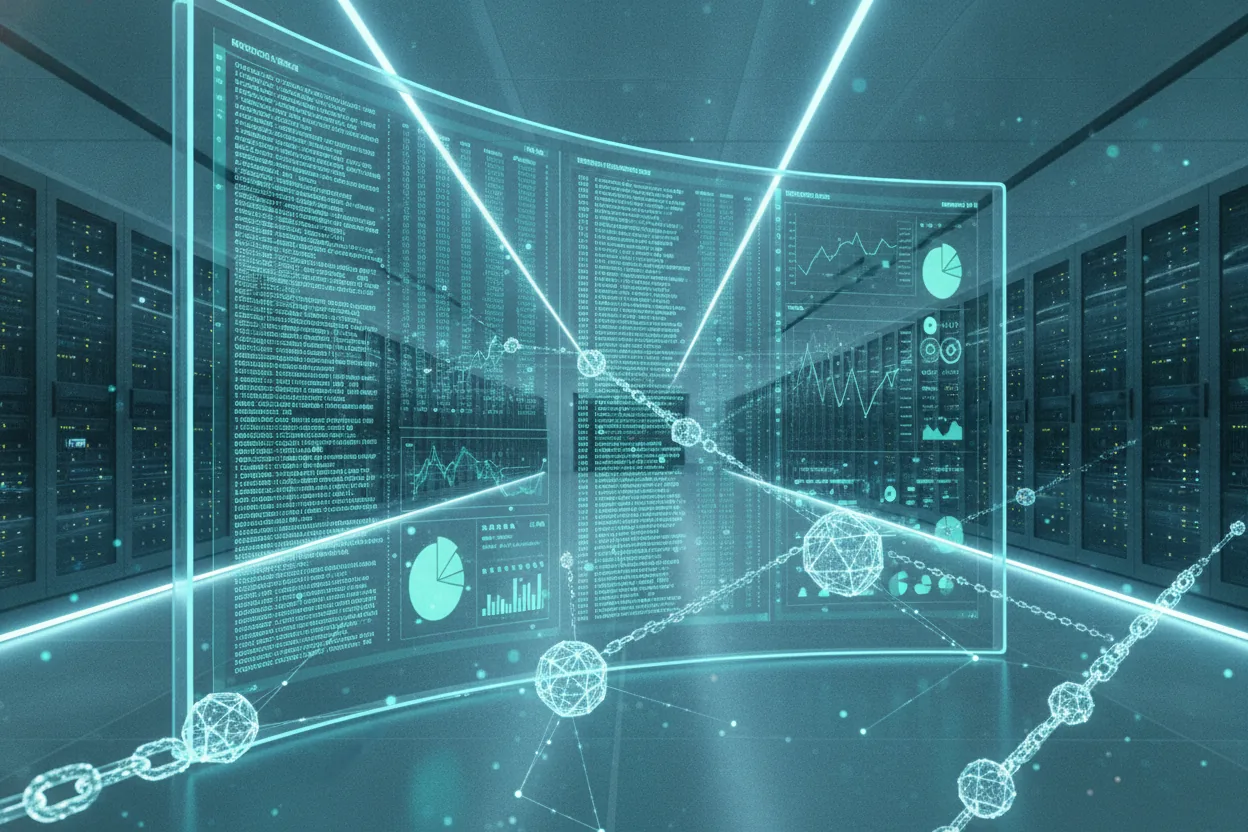
AI-enhanced oracle networks are the mechanism being deployed to address this. Traditional oracle systems aggregate price feeds from multiple sources and use consensus mechanisms to filter outliers. The newer generation of oracle infrastructure adds AI layers that can detect manipulation attempts in the underlying data sources, model the reliability of specific data providers over time, and flag anomalies in asset valuations that diverge significantly from comparable assets. For tokenized real estate specifically, AI models trained on comparable sales, rental yield data, and local market indicators can provide a second verification layer against human-reported valuations.
Counterparty risk for tokenized assets is also partially an AI problem. When a tokenized bond represents exposure to a specific corporate borrower, the creditworthiness of that borrower needs continuous monitoring. AI systems pulling from public filings, news sentiment, supply chain data, and onchain payment history can generate real time credit signals that update a token's risk profile faster than quarterly ratings agency reviews. Several tokenization platforms operating in the institutional space were piloting exactly this kind of dynamic credit scoring through the first half of 2026.
What the tokenization wave is exposing is that blockchain alone doesn't solve the garbage-in garbage-out problem. Immutability is only valuable when the data being made immutable is accurate. AI is being positioned as the quality control layer sitting between messy real world data and the clean onchain record. That positioning has real merit, and it also creates a new concentration of trust in whatever AI models are doing the filtering. The firms controlling those models are, for the moment, a very small group of infrastructure providers with significant and largely unexamined leverage over the integrity of tokenized asset markets. That concentration is the systemic risk the industry hasn't yet built a credible answer for.
How Governance Automation Tests the Limits of Decentralization
DAOs have spent the last four years discovering that token-weighted voting produces predictable pathologies. Low participation rates, plutocratic outcomes where large token holders dominate every vote, and governance attacks where proposals get passed during low-activity windows have all occurred at scale across major protocols. AI governance tools are being developed to address specific parts of this problem, and the approaches vary significantly in how much autonomy they actually hand to the AI layer.
The most conservative application is AI-assisted proposal summarization and impact modeling. Before a governance vote, an AI system analyzes the proposal code, estimates its financial and operational impact on the protocol, flags potential conflicts with existing governance decisions, and surfaces that analysis to token holders in plain language. The decision still belongs to humans. Several large DeFi protocols implemented versions of this through 2025 and reported measurable increases in informed participation. The AI layer in these cases functions as a translator rather than a decision maker, which keeps accountability structures intact.
More aggressive implementations give AI systems limited autonomous execution authority within pre-approved parameter ranges. A protocol might authorize an AI risk module to adjust interest rate curves within defined bounds without a governance vote, reserving votes for larger structural changes. This creates operational efficiency at the cost of a genuine philosophical tension: a system claiming to be decentralized is delegating real authority to an AI model whose weights and training data are controlled by a specific team. Who audits the auditor is not a rhetorical question in this context. It's an unsolved governance problem that no major protocol has answered convincingly.
Cross-chain governance coordination is the frontier problem. As protocols operate across multiple chains simultaneously, coordinating governance decisions that affect all of them becomes logistically complex. AI systems that can monitor governance activity across chains, detect inconsistencies between parameter settings on different deployments, and flag coordination failures before they create exploitable gaps are actively being prototyped. Whether any of them will be trusted with real authority at scale is a question 2026 is beginning to answer through a series of live deployments.
The honest observation about AI governance tools is that they're being built by the same teams that control the protocols they govern. That's not an accusation of bad faith. It's a structural fact about where the technical capacity currently sits, and it means the independence claims built into these systems deserve the same scrutiny as any other financial infrastructure product designed by the institutions it's supposed to constrain. The decentralization narrative is real in some dimensions and entirely nominal in others. AI governance is currently one of the dimensions where the gap between the claim and the architecture is widest, which makes it the most important dimension to watch as real capital scales into these systems.
This article is for informational and educational purposes only and does not constitute financial, investment, legal, or insurance advice. The views expressed are analytical observations and should not be relied upon for personal financial decisions. Always consult a qualified financial advisor before making investment or insurance decisions.